A customer pulled into our New Port Richey store last season worried about a slow leak. Her tread was deep enough to look almost new. She had put a few thousand miles on the car in several years, mostly short runs to the grocery store. The tread was fine. The rubber was finished.
That combination catches a lot of good drivers in West Pasco County. It is what happens to rubber that spends most of its life sitting still in Florida sun. If your car spends more time in a New Port Richey or Port Richey driveway than on the road, tread depth is the wrong thing to be watching. What you want to look at is the condition of the rubber itself.
Here is what dry rot tires actually look like up close, and where a driveway inspection stops being enough.
Why Good Tread Can Sit on a Bad Tire
Tread depth measures one thing: how much rubber the road has scrubbed off. It tells you nothing about whether the rubber that is left is still doing its job.
Rubber ages chemically. According to the National Highway Traffic Safety Administration, the aging most likely to affect a tire’s safety is what engineers call thermo-oxidative degradation, the combined effect of heat and oxygen on the rubber compound. What matters for our customers: NHTSA states plainly that tire aging happens whether a tire is driven or not, and that the process speeds up at higher temperatures.
So the car parked under the carport all summer is aging its tires. So is the one making a two-mile trip twice a week. In its report to Congress on tire aging, NHTSA noted that some tire and vehicle manufacturers recommend replacing tires after a set number of years because aging can affect a tire’s safe performance “even if they have adequate tread and proper inflation.”
That one line is the whole reason we wrote this. Good tread and correct pressure are not a clean bill of health.
What Dry Rot Actually Is
Dry rot is not rot in the way a fence post rots. Nothing is eating your tire.
New tire rubber is soft and flexible because it is full of oils and chemical additives that keep it that way. Over time those additives stop working. Porsche’s own owner guidance, quoted in that same NHTSA report, puts it about as clearly as anyone: the belief that tire durability is immune to storage and age “is unfounded,” because the chemical additives that make the rubber elastic “lose their effectiveness in the course of time and the rubber becomes brittle and cracks.”
Brittle and cracked is the whole story. A flexible tire absorbs a pothole on Ridge Road and goes back to its shape. A hardened one takes that same hit as a shock, and the cracks already in the surface are where a failure starts.
This is a different problem from wear, and you diagnose it differently. You are not measuring anything. You are looking and feeling.
How to Spot Dry Rot Tires in Your Own Driveway
Give yourself fifteen minutes, good daylight, and a flashlight. Park on level ground, cool tires, engine off. Then work one tire at a time and do the same four things on each.
1. Start with the side that faces the sun. If your car sits in the same spot in the same direction for months, one side of it takes the afternoon sun and the other does not. Check that side first. It is common to find fine hairline cracking all over the sun-facing sidewall of a tire whose shaded side still looks close to new.
2. Look at the sidewall for crazing. Crazing is a web of fine surface cracks, like the glaze on an old coffee mug. From standing height you will miss it. Crouch down, put the flashlight almost flat against the rubber so the light rakes across it, and the cracks will show up as shadows.
3. Get your fingers into the tread grooves. Run a fingertip along the bottom of a groove, between the tread blocks. Cracks at the base of the groove and at the shoulder, where the tread curves into the sidewall, are the ones that matter most, and they are invisible from above. If you can feel fine splits down there, that tire needs a professional look.
4. Press the rubber and feel it. Push your thumb into the sidewall of a tire you know is fresh, then into the one you are worried about. Fresh rubber gives a little. Aged rubber feels hard and glazed and does not want to move. Once you have felt that difference one time, you will never miss it again.
While you are down there, the U.S. Tire Manufacturers Association also recommends looking for uneven wear, high and low spots, unusually smooth patches, and any other damage. Those are separate problems, often alignment-related, and they belong on the same tire safety checklist you already run through.
And check five tires, not four. Your spare has never touched the road and probably looks perfect. NHTSA’s field study found that tires keep degrading throughout their service life whether they are rolling on the road or sitting in the full-size spare position. A spare that fails when you need it is a bad afternoon on the shoulder of US-19.
Where Gulf Heat and Sun Do the Damage
Heat is the accelerator, and West Pasco has plenty of it.
NOAA’s climate normals for the Tampa area, covering 1991 through 2020, show an average of 94.2 days a year that reach 90 degrees or higher. In 2023 the count was 122 days, with an average daily high of 94.3 degrees in August. Your tires live outdoors in that, every day.
That is not a small effect. NHTSA reviewed a scrap tire study covering Arizona, California, Florida, Pennsylvania, Massachusetts, Oregon, and Illinois. After four years, damage rates were significantly higher in the hot states, and in every comparison, states with higher average temperatures showed higher damage rates than cooler ones.
Insurance data pointed the same direction. NHTSA analyzed tire-related claims reported to one large insurer between 2002 and 2006. Texas, California, Louisiana, Florida, and Arizona held 27 percent of that company’s policy holders but 77 percent of the tire-related claims, and 84 percent of those claims involved tires more than six years old.
Florida is on that list, and this stretch of the Gulf coast is about as Florida as it gets: full sun, hot pavement, and a lot of cars sitting in unshaded driveways from Hudson down to Holiday for months. A garage, a carport, or even a cover over the sun-facing side buys your rubber real time.
Why Low-Mileage Drivers Are the Ones This Catches
The assumption behind a lot of tire neglect goes like this: I barely drive, so my tires are barely used.
The mileage part is true. Federal Highway Administration travel data puts average annual mileage for drivers age 65 and older at 7,646 miles, against 13,476 miles for drivers of all ages. Many of our seasonal customers are well under even that.
The conclusion is what does not follow. Toyota’s owner guidance, quoted in NHTSA’s report, states that tires more than six years old must be checked by a qualified technician “even if damage is not obvious,” and adds that tires “deteriorate with age even if they have never or seldom been used.” Ford’s guidance says tires should generally be replaced after six years regardless of tread wear, and that heat from hot climates can speed up aging enough to require replacing them sooner.
Read that again with a Florida driveway in mind. Low mileage does not protect a tire. It just means the tread will still look good at the point where the rubber has run out of road. If you have just come back to a car that sat all summer while you were up north, the tires deserve a closer look than the mileage suggests.
The Signs That Mean Stop Driving On It
Most of what you find will be a “get it looked at soon” item. A few things are not. If you see any of these, park the car and call us before you drive it again:
- A bulge or blister anywhere on the sidewall or tread. A bulge means the structure underneath has already come apart and only the outer rubber is holding pressure.
- Cracking deep enough that you can see fabric or cord. Once the cords are exposed, the tire is done. There is no monitoring this one.
- Any deformation of the sidewall, including a soft spot, a wavy section, or a place where the tire is not the same shape as its neighbors.
- Deep cracking at the base of the tread grooves, as opposed to fine surface crazing.
Nobody wins by watching a bulge for another few weeks.
Why a Driveway Look Is Not the Whole Answer
Now the honest part. You deserve the full picture, not a checklist that overpromises.
NHTSA’s field study looked at real tires pulled off real vehicles in normal service. It found the internal cracks and separations caused by aging were, in the agency’s words, “nearly all internal to the tire and likely impossible to detect from a visual inspection alone.”
That does not make the inspection above pointless. When you find crazing, groove cracks, or hardened rubber, you have found something real, and it is telling you to act. What it means is that the reverse does not hold. A sidewall that still looks clean does not clear an older tire, because the damage that separates a tread from a belt at 65 miles an hour is happening where you cannot see it.
So treat your own inspection as a trigger, not a verdict. It can tell you to come in. It cannot tell you that you are fine. That is the real answer to when to replace tires that still look almost new: you stop guessing and let someone put hands on them.
Before a Trip Down US-19 or a Longer Haul
Heat and load are what turn an aged tire into a failed one, and a highway run gives it both at once. A loaded car at sustained speed builds heat in the rubber in a way that a run to the pharmacy never does. If your car has been sitting for months and you are about to point it down US-19 or north out of state, run through this before you go, on top of the usual pre-trip tire maintenance.
- Check pressure cold, and check all five. USTMA recommends checking at least once a month, and doing it cold, meaning the car has been parked at least three hours. Underinflation is common: in NHTSA’s field study of 453 on-road tires, about 11 percent of the passenger car tires were below 26 psi, the minimum the tire industry recommends.
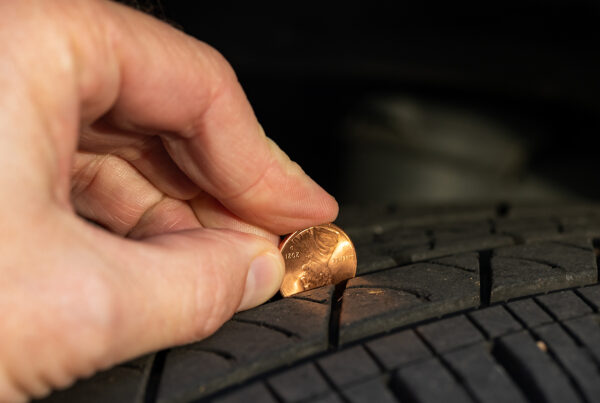
- Check tread depth with a penny. USTMA gives 2/32 of an inch as the minimum safe tread depth. Put a penny upside down in a groove; if the tread covers part of Lincoln’s head, you still have tread to work with. Passing this test says nothing about the condition of the rubber.
- Do the crazing and groove check above on every tire, including the spare.
- Look for anything new since the last time you looked, especially a shape that has changed.
When to Bring It In to a Tire Shop in Port Richey, FL
Come see us if you found crazing, if you felt cracks in the groove bottoms, if the rubber feels hard and glassy, if the car has been sitting for a season, or if you do not know how old your tires are. The date the tire was built is stamped into the sidewall, and we can read it for you in a minute.
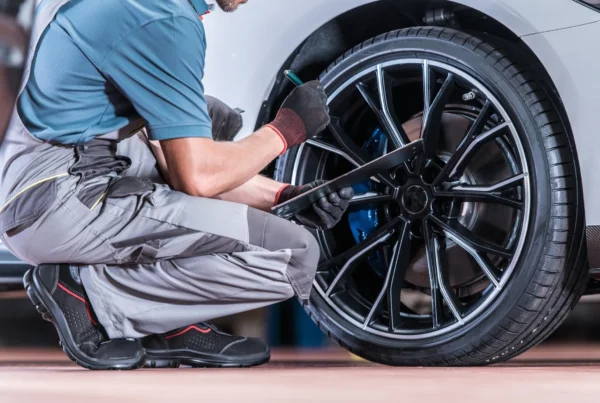
When you bring it in, we look at all five tires in good light, on a lift where we can see the inner sidewalls you cannot reach in a driveway. We tell you which tires are fine, which ones we would watch, and which ones we would not put our own family on. If it turns out you need tire replacement, New Port Richey and Port Richey customers get the same straight talk: we go through what fits your car and how you actually drive it, and you can request a current quote so you have real figures for your vehicle rather than a guess off the internet.
Honest answer either way: if your tires are good, we will tell you so.
George’s Wholesale Tire has served West Pasco County for decades, with two stores close to home in New Port Richey and Port Richey. If your tread looks great and something about your tires still bothers you, trust that feeling and let us take a look. Schedule an appointment and we will get eyes on it.