There is a conversation we have almost every week in our bays, and it usually starts the same way: “It can’t be the brakes. I barely drive this car.”
We understand the logic. Brake pads wear down from friction, friction comes from stopping, and stopping comes from driving. Fewer miles should mean longer-lasting brakes. On a car parked in a garage up north, that logic mostly holds.
Here in west Pasco County, a few minutes from the Gulf, it does not. Brakes around Port Richey and New Port Richey age on two separate clocks. One is the odometer. The other is the calendar, and it runs whether the car moves or not. Salt-laden air, months of heavy humidity, and errand-length trips that never give the brakes a chance to clean themselves add up to a low-mileage car needing brake work that a higher-mileage commuter car does not.
If you are a retiree who drives to the store and back, or a snowbird whose car sits in a carport off US-19 half the year, this post explains what is happening underneath your wheels, and which checks actually matter for you.
Why Your Odometer Is the Wrong Way to Judge Brakes in West Pasco
Start with how little the average car around here actually drives. A Federal Highway Administration table of average annual miles per driver by age group puts drivers 65 and older at 7,646 miles per year, against an all-driver average of 13,476. That is roughly half the mileage of the typical American driver.
Cut that number again for someone who spends part of the year up north, and you have a car covering a few thousand miles annually. Every mileage-based service interval printed in the owner’s manual gets stretched out over years instead of months.
A mileage interval only measures one kind of damage: friction wear on the pad and the rotor face. It says nothing about corrosion, and corrosion does not care how many miles you drove. It cares how long the parts sat in wet, salty air, which around here is most of the year.
So the honest way to think about it is this: your odometer tells you about wear, and the calendar tells you about rust. A real brake inspection in Port Richey has to look at both, because a low-mileage car can be perfectly fine on pad thickness and still have a brake system in rough shape.
Coastal Brake Corrosion in Florida: What Salt Air and Gulf Humidity Do to Brake Parts
Wagner Brake puts it plainly: “Rain, dew, snow and even humid conditions can cause rust to form on brake pads and rotors.” Notice that “humid conditions” is on that list all by itself. Your car does not have to be rained on. It just has to sit in wet air.
And it does. According to Weather Spark’s climate summary for New Port Richey, the muggier part of the year lasts 7.1 months, from April 11 to November 16. August alone averages 30.9 muggy days and 6.9 inches of rain, against 1.8 inches in November, our driest month. For most of the calendar, the air around your brake parts is damp, warm, and carrying salt in off the water.
Brakes are also a tough environment for steel and cast iron. The parts that suffer are not always the ones you would guess:
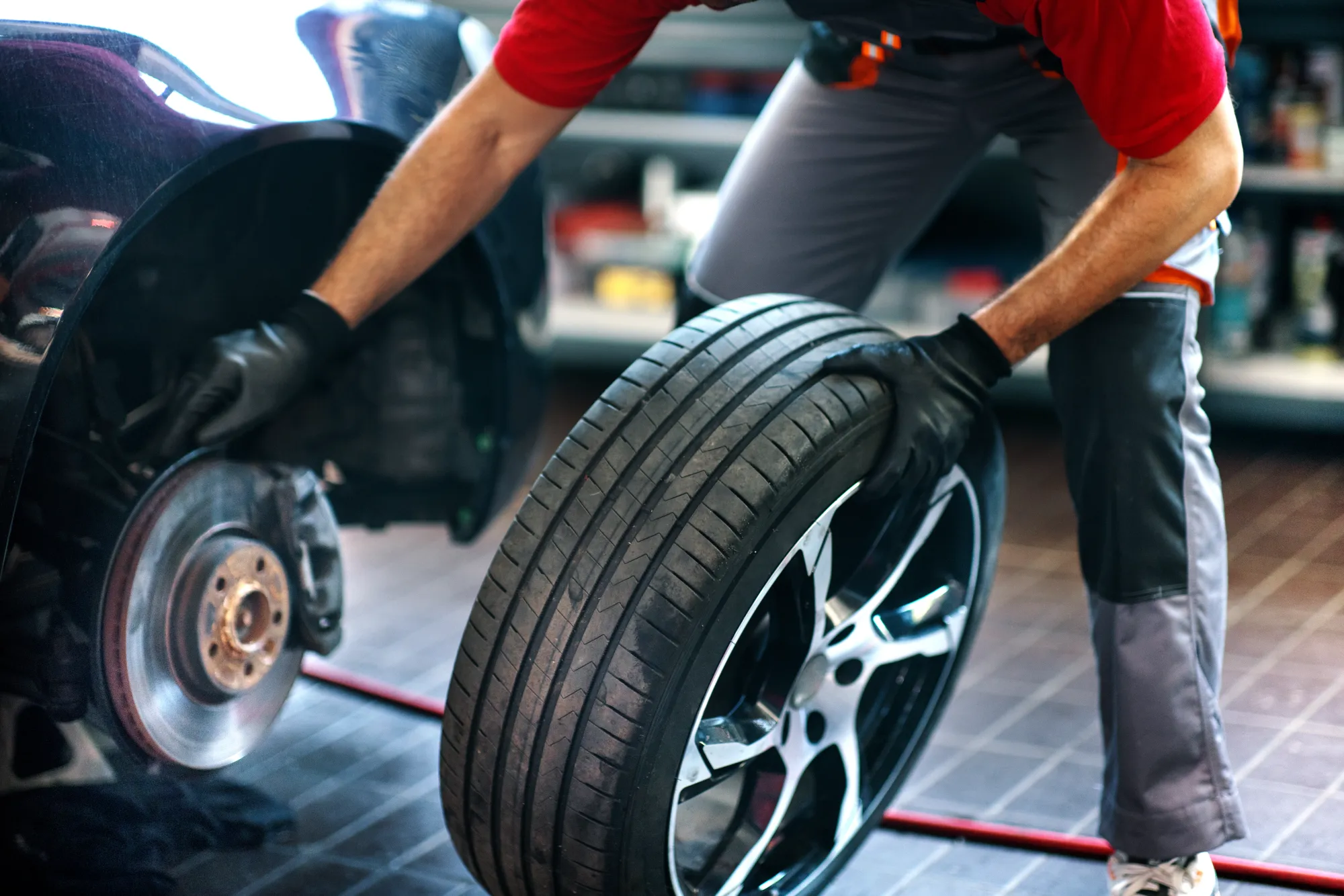
- Rotor faces and, more importantly, the unswept edges. The pad only sweeps a band across the middle of the rotor. The inner and outer edges never get touched, so rust piles up there uninterrupted.
- Caliper slide pins and their rubber dust boots. These are the small pins that let the caliper float so it can clamp evenly and then let go. They live inside a bore, packed with grease, sealed by a boot.
- Brake pad backing plates. The steel plate the friction material is bonded to.
- Hardware, clips, and shims. The small pieces that keep the pads located and quiet.
Coastal brake corrosion in Florida is not dramatic. It is slow and hidden, and it does its work while the car sits in the driveway, which is what makes it easy to miss until something starts making noise.
Short Trips Never Give the Brakes a Chance to Clean Themselves
Here is the part that surprises most people.
Surface rust on a rotor is not permanent. Wagner Brake notes that with regular driving, “surface rust is cleaned off the brake pads and rotors when you apply your brakes.” Every stop is the pad scraping the rotor face clean. Drive normally and you make dozens of stops a day, so the rust never gets a foothold.
That is a mechanical scrubbing action, not a heating or drying effect. What matters is how many times the pads press against the rotor, not how hot anything gets.
Now picture a real west Pasco errand. A few miles to the grocery store, a few miles home, twice a week. That is a handful of stops, and then the car sits for three days in humid air, re-rusting everything the pads just cleaned. The scrubbing never gets ahead of the corrosion.
A car that barely moves at all has it worse. Wagner warns that for vehicles not driven on a regular basis, “the rust can build up and start degrading the structural integrity of the brake rotors,” bringing noise and performance problems with it. That is aimed squarely at a car that spends April through October under a carport, then gets driven onto US-19 in the fall, where the first hard stop is the first real test its brakes have had in six months.
If you have just come back to a car that sat, brakes are one item on a longer list. Our post on what to check before you drive a car that sat all summer walks through the rest of it.
There is a useful tell here, too. If you get grinding on the first two or three stops out of the driveway and then it goes quiet, that is surface rust being scraped off. One morning of that is normal. Every single morning is your car telling you it is not being driven enough to keep up.
The Failure We See Most on Low-Mileage Coastal Cars: Seized Slide Pins
If we had to name the single most common brake problem on a low-mileage car near the water, it is a seized caliper slide pin.
NRS Brakes describes the mechanism: exposure to moisture and salt causes corrosion on the pins that “builds up, restricting movement until the pin is completely frozen in place.” Once a dust boot tears or perishes, contaminants get in, and as NRS puts it, “the pin’s failure is only a matter of time.”
Why does that matter? A floating caliper has to slide to work. The piston pushes the inner pad against the rotor, and the caliper body slides over to pull the outer pad in from the other side. If the pins cannot move, only the inner pad does any work.
NRS identifies the giveaway as lopsided pad wear: “the inner pad (the one pushed by the piston) will be nearly gone, while the outer pad still has plenty of life left.” One pad wears out completely while, in their words, “the other barely works at all.”
And here is the tricky part: you cannot feel this from the driver’s seat until it is well along. The car still stops. Maybe it pulls slightly. Maybe you hear grinding or squealing on the first stops, or feel a vibration through the pedal or the steering wheel. Those are the signs NRS lists, and they show up late.
This is also why “I still have plenty of pad left” is not the same as “my brakes are fine.” Plenty of pad on one side and nothing on the other is a failure, not a reserve, and it only shows up with the wheel off.
While we are in there, NRS recommends that slide pins be cleaned, checked for torn or swollen boots, and re-lubricated with a thin layer of high-temperature silicone-based brake lubricant, never anti-seize or petroleum products, as part of every brake job. If you are having brake work done anywhere, that is a fair thing to ask about.
Rust Jacking and Pitted Rotors: Damage With No Mileage Behind It
Two more corrosion failures worth knowing, because neither has anything to do with how far you drove.
Rust jacking. The friction material on a brake pad is bonded to a steel backing plate. Wagner explains that corrosion on that plate can cause the friction material to delaminate, which increases noise, vibration, and harshness. In plain terms, rust forming under the friction material can lift it off its own backing plate. We have pulled pads off very low-mileage cars where the friction material was visibly lifting at the edge. That is a moisture failure, not a wear failure.
Pitted rotors. Not all rotor rust is bad news. NRS draws the line between a “light, even orange haze,” which is normal and gets swept off, and “deep rust pitting or flaking,” which is not. Once a rotor is genuinely pitted, the high spots “act like a file, grinding down the pad material in one area,” and the rotor needs replacing. A car that sits gets far more chances to cross from haze into pitting than a car that drives daily.
Brake Fluid Runs on a Calendar, Not an Odometer
If you want the clearest example of a brake service that has nothing to do with miles, it is the fluid.
Brake fluid absorbs water out of the air over time whether the car moves or not. ADVICS explains that a fluid’s “wet” boiling point is measured with fluid that has been contaminated to 3.7% water by volume, and that DOT 3 fluid typically reaches that saturation point in roughly one year of use, versus roughly two years for DOT 4.
No mileage trigger is involved anywhere. A car that covered 2,000 miles last year has fluid just as old as one that covered 20,000. Water in the fluid lowers its boiling point and brings corrosion inside the system, to the very bores and pistons that already have moisture pressing in from outside.
This is why we ask how old your fluid is rather than how many miles are on it, and why so many low-mileage cars arrive here with fluid years past due, because nothing in the maintenance schedule ever went “ding.”
The Time-Based Brake Checks That Matter in Port Richey and New Port Richey
Here is what we would actually put on your calendar, in place of a mileage number:
- Get a brake inspection at least twice a year. Not at a mileage figure, at a date. Pairing it with something you already do, like a tire rotation, is the easy way to remember.
- Inspect before a long sit and after it. Before, so nothing is left dragging for six months. After, so anything that seized while parked gets caught in the driveway instead of in traffic on US-19.
- Ask for pad thickness at all four corners, not one number. A lopsided pair on the same wheel is the slide-pin signature, and comparing corners is how it gets caught early.
- Ask what the rotor surfaces look like. Even orange haze is fine. Pitting or flaking is a different conversation.
- Ask when the brake fluid was last replaced, by date. If nobody can tell you the year, that is your answer.
- Ask that slide pins be cleaned and re-lubricated with any brake work. On a coastal car, that is not an upsell. It is the difference between the repair lasting and the repair repeating.
None of this requires you to drive more. It just means judging your brakes by how long they have been living in salt air rather than by a number on the dash.
Book a Brake Inspection Before Your Brakes Pick the Timing
If your car is low-mileage, lives near the water, or just spent a season parked, book it in. We will pull the wheels, measure all four corners, check the slide pins and boots, look at the rotor surfaces, and tell you honestly what needs doing now and what can wait.
We are happy to walk you through what any recommended brake service would involve, and we will give you a current quote for your specific vehicle before any work starts. No surprises.
If you have been searching for brake service in New Port Richey, or want a straight answer about a brake inspection in Port Richey, we are right here in west Pasco. Schedule an appointment at either of our locations, and let us take a look before your brakes decide the timing for you.