You bring the car in because something changed. A squeal as you slow for the light on US-19. A pedal that feels softer than it did last spring. Whatever the symptom, the sentence you get back is usually the same four words: you need brakes.
Those four words cover a lot of ground. They can mean a set of pads and nothing else. They can mean pads and rotors. They can mean a caliper that is no longer releasing, hardware that has corroded stiff, or fluid that quietly went past its useful life a couple of years ago. Two cars can roll into the same shop here in Port Richey with the identical complaint and leave with genuinely different repairs. That difference is what the measurements said.
Most brake articles stop at the diagnosis. We have already written about the warning signs that mean your car needs a mechanic, so this one starts where that one ends. The part customers actually find confusing is what happens after the wheels come off, so here is how a technician decides what your car needs.
“You Need Brakes” Is Not One Job
Your brake system has a friction half and a hydraulic half. The friction half is what you can see with a wheel off: pads squeezing a spinning rotor, held by a caliper. The hydraulic half is the fluid, the lines, and the master cylinder that turn your foot into clamping pressure.
Any of those can be the reason your car stops badly, and each one is a different repair with a different scope. A pads-only job touches the fewest parts. Adding rotors adds parts. Freeing or replacing a caliper adds more, because the technician has to get into the sliding hardware, and a replaced caliper means bleeding that corner afterward. A fluid service is its own item, and it has nothing to do with how much pad is left.
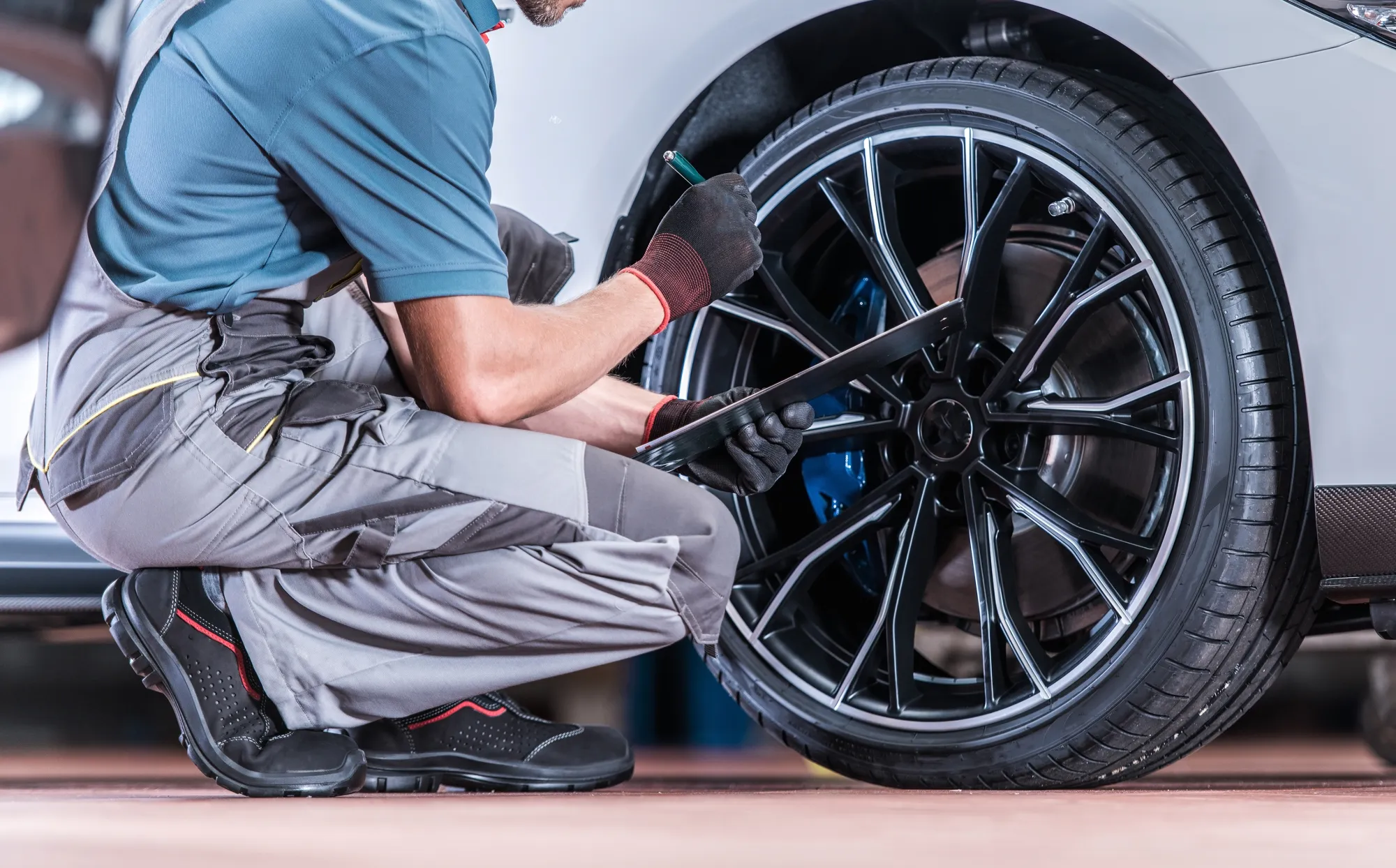
The only way to know which combination applies to your car is to pull the wheels and measure. Not look. Measure. Everything below is a number compared against a specification, not a judgment call, and that is exactly what honest brake repair in Port Richey should look like.
Brake Pads: The Wear Item With a Number On It
Brake pads are designed to wear out. That is their job, and they come with a number attached.
A new pad is roughly 12mm of friction material, about half an inch. Most manufacturers call for replacement once that pad is about 75 percent worn, which lands right around 3mm. That 3mm figure is not arbitrary, and it is why your car usually tells you before we do. Pads carry a small metal wear-indicator tab set to touch the rotor once the material is worn to about that point, and the result is the high-pitched squeal you have probably heard in a parking garage. Cars with electronic pad sensors light a dash warning at a similar point.
According to Haynes, there is no federal minimum brake pad thickness standard in the United States, so the number that governs your car is the one your vehicle manufacturer published for it.
Two takeaways from that 3mm mark:
- A squeal is a scheduled repair. The squealer tab exists to give you lead time. If you hear it, you still have some road left, and you get to pick the day.
- A grind is not. Grinding usually means the friction material is gone and the backing plate is riding on the rotor. The pad is no longer the only part in the conversation at that point, and what could have been a straightforward brake pad replacement in New Port Richey has grown to include rotors.
The gap between squeal and grind is where most of the difference in scope on a brake job lives, and it is entirely under your control.
Rotors: Measured, Not Guessed
Here is the part almost nobody outside the trade knows: your rotors have a minimum thickness stamped right on them, usually into the rotor hub, though some manufacturers use the outside edge. That number is the discard specification, and it exists because a rotor thinner than that cannot do its job.
The eye-opener is how little wear margin there is. Take the front rotor on a 2010 Ford Focus. New, it measures 22mm. Its discard thickness is 20mm. The entire allowable wear for the life of that part is 2mm. That is less than two business cards stacked together.
Now add machining to the picture. Turning a rotor on a lathe to clean up scoring or glazing removes roughly 0.4mm to 0.5mm from each side, so 0.8mm to 1.0mm total in a single cut. On a 2mm budget, that one cut eats about half of everything the rotor had. Truing up a rotor that has worn unevenly takes even more.
The trade also works in a margin: the machine-to figure sits about 0.015 inch above the discard figure, and when no machine-to number is published, technicians add that 0.015 inch themselves. A resurfaced rotor still has to survive a whole new set of pads without dropping below its limit.
So when a technician tells you the rotors have to be replaced rather than turned, this is the arithmetic behind it. A rotor sitting at 21mm might measure legal today, but after a cut it is at or below 20mm with nothing left in reserve. Below the discard number, a rotor cannot absorb heat properly or hold its shape under load, and it can crack or warp.
That is also the honest answer to a pulsing pedal at highway speed. A pulse often traces to uneven rotor thickness rather than to worn pads. Machining could flatten it out, but if flattening it out puts the rotor under spec, replacement is the only recommendation that holds up.
Calipers and Slide Pins: Why Our Coastal Air Matters
Most cars on the road use a floating caliper. Rather than clamping from both sides at once, the caliper body slides on a pair of greased pins, so the piston pushing on the inner pad also pulls the outer pad in. Both pads end up applying roughly the same force to the rotor, as long as the caliper can slide.
In west Pasco County, sliding is the problem. Those pins live in a hot, humid, salt-touched environment a few miles off the Gulf, and three things stop them moving: corrosion, grease that has dried out and hardened into glue, and torn rubber dust boots that let water and grit inside.
A seized pin leaves a signature a technician can read straight off the parts. The inner pad is nearly gone while the outer pad still looks close to new. The piston kept pushing, the caliper never slid, and one pad did all the work. If you have ever wondered how a shop knows a caliper is bad without any special test, that lopsided pair of pads is how.
The repair depends on what is actually seized. Often it is a service rather than a replacement: pull the caliper, clean rust and old grease off the pins, inspect the dust boots, apply a thin coat of high-temperature silicone-based brake lubricant, and torque everything to specification. If the piston itself is corroded, or a boot is torn, or the caliper is leaking, the caliper gets replaced and that corner gets bled.
“Caliper” on a line item can mean either one, which is why an estimate deserves a careful read.
Brake Fluid: The Half of the System You Cannot See
Brake fluid absorbs water out of the air, which is a real problem in Florida humidity, and the federal standard for brake fluids puts numbers on what that costs you.
Under FMVSS 116, DOT 3 fluid has to boil no lower than 401 degrees Fahrenheit when it is dry. Once that same fluid has taken on water, the requirement drops to 284 degrees Fahrenheit. The standard defines “wet” as a water content of 3.70 percent by weight. DOT 4 is held to a higher bar at both ends, 446 degrees dry and 311 degrees wet, and it falls off in the same direction.
That gap of well over a hundred degrees is what a fluid service buys back. Water lowers the temperature at which fluid vaporizes under hard, repeated braking, and vapor compresses in a way liquid does not. That is the soft or sinking pedal that has nothing to do with how much pad is left.
General guidance from the Motorist Assurance Program is to replace brake fluid about every two years and to check the level roughly every six months, with published intervals ranging from one to three years depending on the manufacturer. If your pedal feels spongy but your pads measure fine, the hydraulic half is where to look. Good brake service in Pasco County looks at the fluid, not only the friction parts.
Why Two Cars With the Same Complaint Get Different Work
Two scenarios, both common here.
Two identical crossovers arrive the same week, both squealing at low speed. The first measures about 3mm of pad at all four corners, with rotors still above the machine-to number. It gets pads and hardware, and it is out quickly. The second has an inner front pad worn down to the backing plate while the outer pad looks almost new. That is the seized slide pin signature, and that car needs caliper work along with pads and rotors, because the rotor that pad was grinding on will not measure up.
Same complaint. Same model. Very different estimates, decided entirely by what the calipers and the micrometer found.
Driving patterns do the same thing. A retiree running short errands along US-19, stoplight to stoplight, applies the brakes far more times per mile than someone doing open highway miles, so their pads reach 3mm sooner even at low annual mileage. A snowbird’s car that sat in a New Port Richey driveway from May through October comes back with a rust film on the rotors and, sometimes, a pin that corroded while parked. The film scrubs off in the first few stops. The pin does not free itself.
For local fleet trucks, loading changes the math again. Florida law requires service brakes adequate to control, stop, and hold the vehicle under all conditions of loading, and a violation is a noncriminal traffic infraction. The inspection has to satisfy the loaded truck, not the empty one.
What to Ask When the Estimate Comes Back
You do not need to know brake theory to ask good questions. Ask these:
- What did the pads measure, in millimeters, at each corner? A real answer has numbers in it.
- What did the rotors measure, and what is the discard spec for my vehicle? The second number is stamped on the part.
- Are the rotors being machined or replaced, and why that one? If replaced, the answer should come back to that thickness math.
- Is anything being serviced rather than replaced? Cleaning and lubricating slide pins is a different job than fitting a new caliper.
- Is brake fluid included, and when was it last done? It is easy to overlook, since nothing about it squeals.
- What needs doing now, and what can safely wait until the next visit? An honest shop will separate the two.
- What is the current price for exactly this scope of work? Ask the shop directly. Parts and labor vary by vehicle and by what the inspection found, so a national average tells you nothing useful about your car.
Please do not price a brake job off the internet. Ask us for a current quote on your specific vehicle once we have measured it, and you will get a number that actually applies to you.
Straight Answers on Brake Repair in Port Richey and New Port Richey
We recommend a brake inspection once a year or every 12,000 miles, whichever comes first. It is a short visit, it produces the measurements above, and it is what turns “you need brakes” into a specific, explainable list. Our brake service covers pad and rotor replacement, caliper repair, brake line repair, ABS diagnostics, hydraulic repair, and fluid checks and flushes, at both our Port Richey and New Port Richey locations. If the work turns out to be more than you planned for this month, our Road Ready Financing can spread it out.
Squealing, pulsing, pulling to one side, or a pedal that just feels different than it used to? If you have been searching for brake service near you in west Pasco County, schedule an appointment and we will put it on the lift, take the measurements, and show you exactly what we found before we touch a thing.